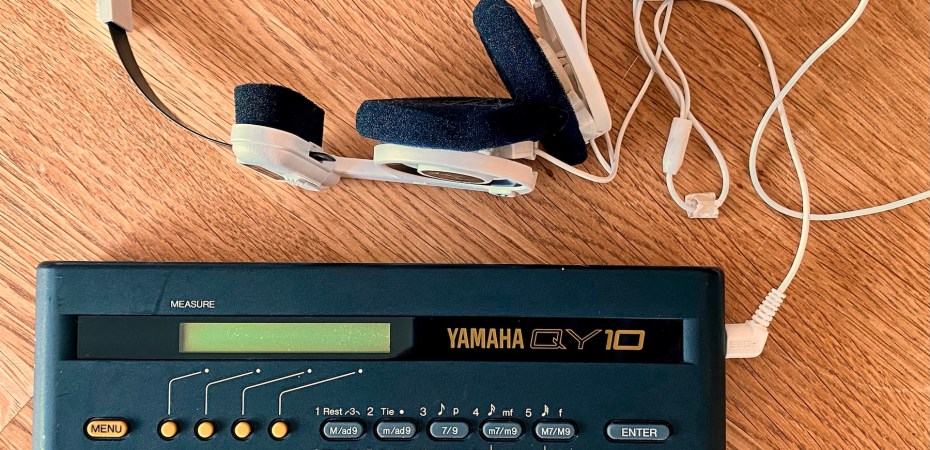
Yamaha launched the QY10, a battery-powered pocket-sized-ish combination of a sequencer and a multitimbral synthesizer in 1990. It would run for quite a while on AA batteries, and came neatly packaged in something reminding of a VHS cassette cover, which would indicate its size, if you are born no later than the 90’s, that is.
While the term “walkstation”, a portmanteau of “Walkman” (portable cassette player) and “workstation” (general term for synthesizers with built-in support for song recording) never caught on, it’s a good description of the first capable groovebox to hit stores.
I bought one during my last year as a student with the intention of bringing it on trips and to cafés to enable me to capture musical ideas when on the move, long before laptops and mobile phones. However, after struggling with the meager 30 onboard, uneditable sounds and the cryptic sequencer for a while, I gave up and sold it.
But what was a small parenthesis years ago in a more or less continuous flow of music gear I have tested, turned out to hold quite a bit of nostalgic value, so on a whim I recently picked one up in immaculate condition, with all original peripherals (including an extremely fetching nylon carrying bag that screams of the 90’s) with a single purpose – to see whether the added years of experience with musical theory (and obtuse sequencers) had prepared me better for the task:
Would I finally be capable of creating a song using just the QY10?
Walkstations in general
Looking at the specs of the QY10, it feels a bit like Yamaha were testing the waters at the time. The non-editable sounds are bland enough to be useful (not counting the unfortunate inclusion of a distorted “guitar” and “saxophone”) but the lack of any editing or effects would make a QY-exclusive album a bleak proposition. Perhaps not too surprisingly, the QY10 was successful enough to pave the way for an entire line of QY devices, including the surprisingly powerful (and equally cryptic) QY70, ending with the not-so-walkable QY700 that merged all of the QY style sequencing into a desktop studio sequencer.
The QY20 offers more sounds and a large screen, the QY22 adds GM sounds (because why wouldn’t you?) and the QY70 adds effects and ups the sound quality quite a bit. But, the QY10 was first on the scene, and is thus the most interesting to me.
The QY way
Creating songs on the QY10 is quite a different affair compared to almost anything else, and when I encountered it first time around, I found it quite alien to be honest. As someone who has worked with several of Yamaha’s legacy sequencers (QX1, QX3 and QX5) the concept of “jobs” – a way to quickly access functions through a menu system – was familiar to me, but the way of recording songs and ideas was not.
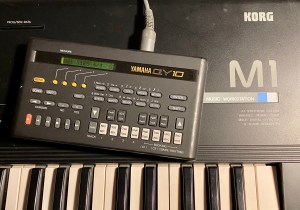
Actually, the most intriguing part of the workflow works like this: When you create patterns, that you string together to form a song, you are supposed to create all patterns in the key of C, in order to add chord progressions later! That’s right – programming the rhythm and melody is separated from the chord progression and key, and this is also what makes creating songs on the QY10 such a special experience.
When creating patterns, you can draw inspiration from the 76 preset backing patterns ranging from the ubiquitous bossa-nova to Caribbean Electronic (?) . In practice it’s not as stupid as it sounds, as some of the less esoteric presets offer a sketchpad foundation to use while you draft your beat, and using elements of the drum or bass patterns can be a quick way to get backing for your song idea. But, the built-in sounds might prove more of a challenge.
Voices of the QY
The QY10 offers exactly 30 non-editable sounds to choose from, and exactly one drum kit, which thankfully includes both an acoustic and an electronic (slightly 808-inspired) kit respectively. While the selection of sounds is reasonably sound (heh), there’s the unfortunate horrific distorted guitar taking up one valuable spot, and depending on your preferences, the various tines and bells might also be wasted on you, leaving us with a few synth lead/bass, pianos, muted guitars and other useful instruments, including a very Seinfeld-esque slap bass.
When I say non-editable, Yamaha means it. You can’t alter the sounds in any meaningful way apart from their level, which ultimately reduces the usefulness of the QY10 quite a bit. Things were better with the later models which introduced various sound shaping tools and even filters, but Yamaha were obviously keeping costs down when they tested the concept.
The one thing you can do to make things more interesting is to transpose the sounds way out of their “normal” pitch range, which introduces aliasing and frequency warping in interesting way. Especially pitching sounds up can generate very interesting sounds vaguely reminiscent of resonant filter blurps, but the lack of on-board EQ means that you will have to tame the aliasing post recording in your DAW. (This is akin to the transpose trick of the Kawai K1 that can transform static samples into warbling semi-random goodness)
Pattern Matching
Each pattern consists of four tracks: Two “Chord” tracks, a third for bass, and the fourth for “Rhythm”. You have 24 user patterns available, and the additional 76 presets from which you can copy individual tracks to piece together your own patterns if you so wish.
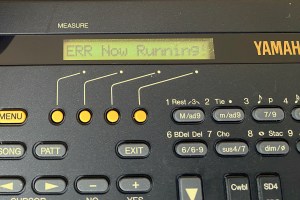
When creating the full song, you string together a number of pattern, chord, and bass changes in a sequence. This actually works quite well in practice, and on top of that, you have four linear tracks that run in parallel with the patterns. This mimics – albeit in a slightly odd way – the operation of MPC’s and certain DAW’s where you build your song from repeating patterns that can be overdubbed with linear tracks. The approach to sequence chord and bass changes later will be slightly awkward at first, but I actually found it refreshing, and it made it simple to experiment with different chord progressions as I went on. While I would not want to work this way on every track I make, it is a fun approach that helped me break from my normal groove and create different stuff.
I used to own the top-of-line QY70, and also for a short while the awkward bigger brother QY300 which is neither portable nor a full-blown sequencer like the QY700, and I could never really get into the workflow of neither of them. Now, seeing them as tools to approach music from a different direction, I think I would appreciate trying one of the bigger boxes with editable sounds much more.
The Results
While figuring out the QY10, I created a number of tracks, one of which actually was decent enough to record. The lack of individual outs required me to painstakingly record it track by track (although the process could be sped up a little by hard-panning tracks left and right and recording in mono) into Ableton Live where I synchronized things up again. No overdubs were made, but the track has been mixed and mastered post recording, with a bit of added delay and reverb, and I used Baby Audio’s excellent Transit plugin for fills and small breakdowns as it is quite fiddly to achieve something even remotely similar on the QY itself.
It turned out a little thin on the bass side, more due to an unfortunate choice of bass sound from my side rather than the QY10, and I didn’t want to overdub it afterwards, so apologies in advance. (The track was BTW named by a friend who commented “it sounds like Indiana Jones in Egypt”)
Enjoy, and let me know your thoughts on the QY range of Yamaha sequencers, and whether anyone actually used these in a professional setup back in the day?
 The Introvert
Very nice to see that thing live a much worthier life thanit did in my studio storage room 🙂
LikeLike
Much obliged for getting the opportunity to revisit my unfortunate bout with QY sequencers from decades ago, only to come out with a more positive experience this time around 🙂
LikeLike
It’s a Revenge of the Nerds vibe!
LikeLike
Ha ha, I used to own a TG-100 and I so remember the bell sound … nice song btw :-).
LikeLike
good article and good work on the track. Remember programming mine to do a version of Strange Day by the Cure that I used as a backing track to play my guitar to. I still have the thing. I am sure I had it sequencing my Korg 707 as well though can’t recall how!
LikeLike