In my last post, I got myself an early Christmas present, only to find out it came with a broken slider. Thanks to Jam, where I purchased it, I got a replacement quickly and has since been using the EP-133 on and off to make beats and song ideas. I will post some of my thoughts and experiences here, with the usual caveat that they reflect my personal views and your impressions may be different altogether.
The Slider, and Overall Design
Let’s address the elephant in the room first: After using the EP-133 for a while now I no longer think the slider will break any time soon. Once the tip is in place, it feels sturdy and can’t be pushed down to cause any damage (unless you apply enough force to break the case, that is). It travels smoothly and soon becomes second nature to use. It seems this was an issue with how the units were being transported in bulk, and Teenage Engineering have apparently added extra padding since becoming aware of the problem.
The overall design is a welcome change from the norm. The unit is incredibly lightweight, yet does not feel fragile. If you toss it in your bag, you won’t notice the extra weight. In my first post, I questioned the wisdom of using AAA cells instead of AA, but they seem to last quite a long time, helps to reduce weight, and you can always power it from USB instead.
I also find the size almost perfect, with a pleasant travel to pads, keys and sliders. I didn’t expect to get MPC pads for the prize, yet I find the keys and “pads” perfectly fine to use. Calculators back in the day were made to be used as everyday tools in offices around the world, and it seems to me that the design ethos of the EP-133 stretches into the tactile territory instead of just being inspired by looks alone.
While the display retains the playful style of previous TE products, it conveys quite a bit of useful information at a glance – a welcome departure from the Pocket Operators where the display appeared to be more of a fun distraction. And there’s something about the colorful clarity of the display that invokes creativity in me. I don’t know whether this is a VFD display or not (I suspect not), but it looks like one, and it reminds me in a good way of old electronic games and programmable calculators. To me, it helps bring me into a mode of creative playfulness, but I recognize that will be all up to your personal frame of reference.
In Use
The EP-133 is instant-on and instant-off, retaining your work without need to explicitly save it. It’s amazing to me that this is still uncommon with technology today, and it’s a strong sales argument. While I understand there’s a magnitude of difference in complexity of their respective operating systems, my MPC Live requires quite a bit of time to start up, and load my latest project (something it can’t do automatically on power-up, apparently). This creates a distinction where the MPC becomes more of a “computer” and the EP-133 an “instrument” to me.
Song Creation vs. Sound Design
Back in the day, when I started to experiment with sampling a bit more, I remember coming back home with a Boss SP-202 freshly bought from the local music store. I also remember selling it a few months later, after realizing that it was only able to play back samples with a bit of effects. It was later, when I got the Ensoniq ASR-X with the ability to resample sounds and sequences with added effects that I rediscovered the joy of crafting sounds and musical textures at the same time, but now in the digital world.
The EP-133 sadly, does not offer resampling, so that avenue is closed at the moment, which in a way gives me the same feeling of something missing as I had after a few weeks with my SP-202.
The Caveat
When buying gear in the ’90s, and even early to mid 2000’s you usually ended up with what you expected from the specs. Sure, there were updates, often in the form of EPROM chips to be precariously replaced inside the machine, but they rarely offered new functionality, instead fixing some of the most glaring bugs. (Unless you owned the aforementioned ASR-X, but that’s a story for another time)
Today, with most gear being released in unfinished format, you often buy into an expectation. The expectation of the EP-133 is that it will have its functionality extended over time, through software updates – but there’s no guarantee! Therefore, some of the conclusions in this article may become irrelevant after February 2024 when it was written. (Resampling being one such thing I personally hope to be wrong about in the near future)
Song Creation and Limitations

I’m a big believer in limitations fostering creativity, and it is remarkable to note how many interesting things have been created with surprisingly limited means (The “Endtroducing” album by DJ Shadow, almost entirely made with an MPC60 comes to mind as perhaps one of the most obvious examples).
With that said, my main reason for getting the EP-133 was that I love the design thinking behind almost all of TE products, and being especially enamored by the Pocket Operator range (which has to be one of the most immediate ways to get non-musicians hooked on creating loops and beats by the way), I was hoping for the EP-133 to be the start of a collection of more “Reasonably Sized Operators”.
It is, and it isn’t.
First and foremost, the EP-133 builds on the PO-33, but surprisingly it lacks two important features from the Pocket Operator:
Project Backup and Memory Concerns
Yes, in its current incarnation, the EP-133 can’t backup its entire memory! You have to make do with either tracking out your patterns to a DAW, and/or using the web based sample tool to move samples between your computer and EP-133.
What makes things slightly worse is the surprisingly low memory limit of just 64 MB (!)
At first, I thought it would be less of an issue, but those megabytes sure filled up surprisingly fast, and now I’ve entered the realm of sample optimization and organization. As in “do I really have need for this 4 second atmospheric sample?”. (This also reminds me of my old ASR-X, again not necessarily in a good way).
I eventually found that I had to approach the EP-133 in a different way. I won’t use it for loops and long samples, as I view it more as an instrument akin to my really old samplers such as the Ensoniq Mirage (I have two, because why not?). When I experiment with the Mirage, it’s more about one-shots and single-cycle waveforms processed by envelopes and filters, and I think this is a more appropriate approach with the EP-133 as for now.
Except you can’t loop waveforms with this version of the OS. Sigh.
Non-Punch-In FX?
The second limitation (flaw?) had me even more baffled. The real-time Punch-in ‘FX’, which for me has become such a staple in how I work with the Pocket Operators can’t be recorded to a pattern!
The first incarnations of Pocket Operators such as the PO-12 always recorded Punch-in FX to the pattern, and you had to clear or re-record if you didn’t like the results. Later models changed the behavior to only being record if record was enabled which is perfectly fine, but does take away some of the playful spontaneity.
However, not being able to record Punch-in FX at all seems like a mistake, seeing as I view it as such a unique and fun element of the PO’s, and I sincerely hope this will be added in a firmware update down the line. It’s especially sad as the Punch-in FX on the EP-133 are brilliant and makes clever use of pressure sensitivity of the pads in use.
If I had one further wish for the Punch-in FX, it would be to move the “tape stop” effect from pad 8 to pad 0 or somewhere more off-centre. Or, actually, remove it entirely. It’s the only effect that will totally screw up your performance should you invoke it by mistake, and I think it’s a flaw to have it hidden among the other, less problematic effects. I have now added an adhesive red dot to the “8” pad to remind myself not to accidentally use it when recording.
Describing a Scenario
Given the limitations at hand, what can we do?
The max polyphony of the EP-133 is 12 mono or 6 stereo voices, so there’s that. Assuming we set aside four mono voices on average for drums and percussion (assuming no more than four hits occur simultaneously), that leaves us with up to eight mono or four stereo instruments. Noting that we can also choose from four groups of twelve different sounds, this is plenty for making music.
Another limitation is that we only have a single insert effect, so no combining delay and reverb for instance. Loading or sampling sounds with inherent reverb may seem like a viable strategy, but it risks eventually challenging both memory and polyphony requirements.
No Chop, No Tuna
One idea I had was to assign similar sounds to several pads and playing them slightly detuned to create a thicker ambient sound texture. But alas – you can’t detune sounds! This is slightly worrying, as it implies that you have to prepare your samples to be in tune, or risk becoming famous for composing atonal hip-hop.
I found a few of my installed samples to be slightly out of tune, and they were promptly removed from my sound library for now. Oh, and if you consider using the “Tune” slider parameter to correct things, note that it will have effect on the entire group of 12 sounds!
You can set the root key for a sample to compensate for having samples recorded in a different key, but the value is stored with the track rather than the sound itself, so you find yourself having to adjust the root key for samples every time you want to use them.
Noting the memory limitations, regular tricks of the trade back in the day were to truncate or chop off unwanted parts of samples to free up memory, and convert stereo samples to mono, none of which can be done inside the EP-133 at this point in time. Prepare your samples in advance, to avoid problems later.
Caught in a Loop
Another thing worth noting is that if you want to use your EP-133 to experiment with polymetric melodies or rhythms, while groups can have different lengths, tracks can’t. All tracks within a group will be locked to the length of the group. This does however make it possible to create four groups of different lengths which can yield interesting results!
Moving Past the Limitations
Given all this, what can we do with the EP-133? Well, it’s an incredible fast sketchpad with an interesting take on creating evolving structures where you “commit” your pattern to create a copy to continue working from.
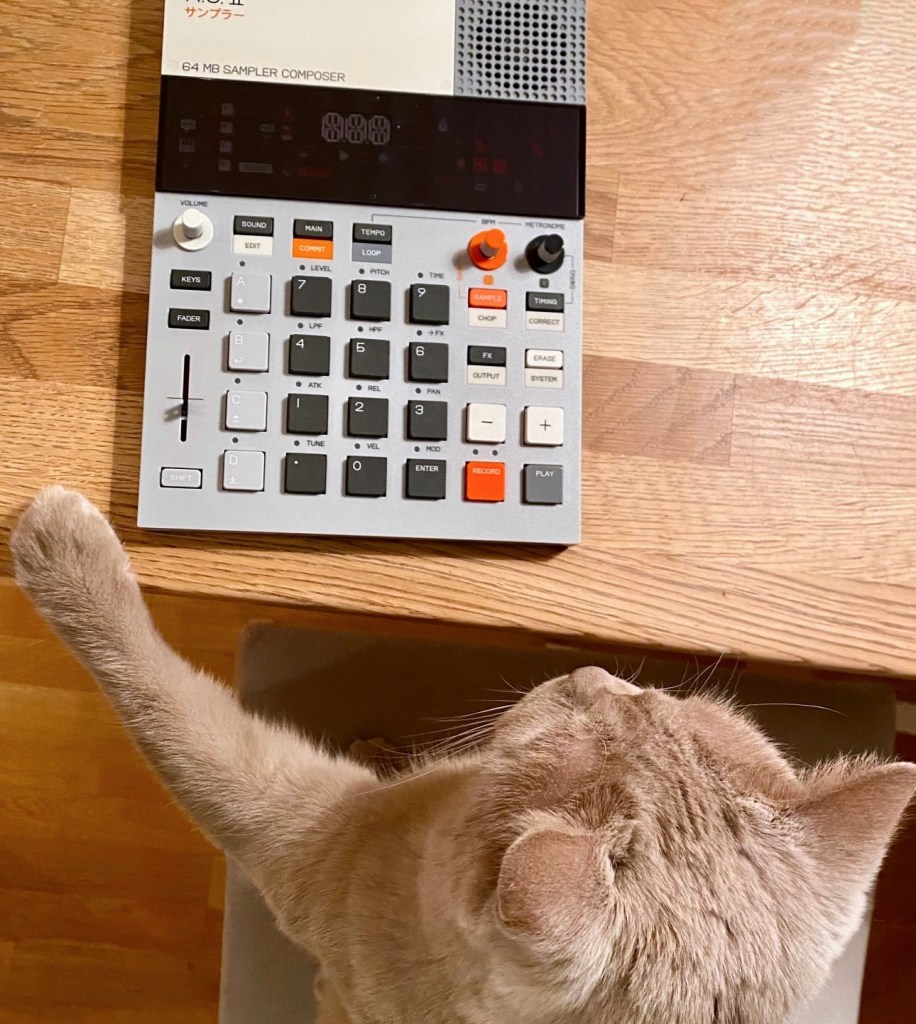
It also provides multiple quick ways to record tracks in step- or real time and manipulate them later – including recording fader movements in real time or as “parameter locks” across all twelve modifiable parameters per group, to add movement and variation to your patterns.
Sadly, there seems to be no quick way to duplicate or extend a track or pattern without resorting to the slightly clumsy “Copy Bar” shortcut (which does what it says – copying the current bar to clipboard, to be subsequently pasted somewhere else). Building a song will require quite a bit more effort than with, say, my trusty old Yamaha QX5FD from the 80’s that have quick functions for extending and modifying parts of patterns and tracks. Perhaps the comparison is unfair, but given the other quick shortcuts of the EP-133 this is also a strange shortcoming.
Conclusion – for now
I would go so far as to state that the EP-133, in its current form, harks back to my early days of sequencing with a Yamaha QX1 and its later sibling, the much improved QX3. They were linear machines, designed to mimic and improve upon tape records, and the concepts of “patterns” and loops where still a few years away. Indeed, this is also reminiscent of Teenage Engineerings’ own OP-1, which lends itself to linear recording, albeit with many support functions to facilitate building the songs from parts.
Another way of looking at it is from a purely live standpoint. You can prepare dozens of patterns, each one building and evolving from the previous, and perform by changing them on the fly, adding live parts and using the amazing Punch-in FX for good measure.
It will be interesting to see what direction of development Teenage Engineering has in mind for their firstborn Reasonably Sized Operator, and if other models will be added.
If no new functionality is to be added, it’s still a powerful, fast, lightweight sketchpad that will find its’ way onto tracks and live sessions, and during my morning sessions, before breakfast but with coffee at hand.
 The Introvert