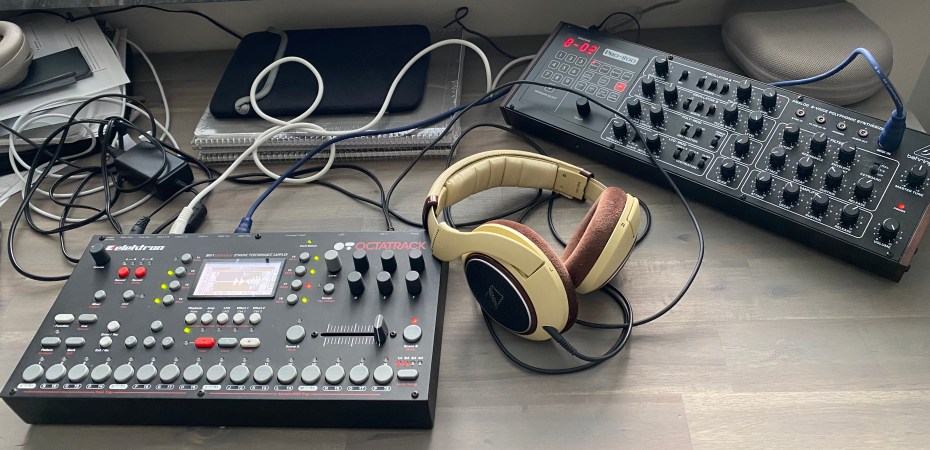
In a move that can only be described as either way overdue, or incredibly foolhardy, I traded my TR-8s for an Elektron Octatrack Mk1. Yes, the first version, the one where they hadn’t yet figured out the proper buttons to put on the front panel, and you have to memorize octopus-like shift-shorthand-key combos for such mundane tasks as getting ready to record, and viewing the actual sample waveform.
This is also the machine which has been known to have grown men either cry or create entire albums in inspiration.
So, given that my first sampler ever was an Ensoniq Mirage, which required you to enter parameters in hexadecimal – how hard can it be?
Hard Mode Activated
I’m actually a manual guy – I know, it’s weird to be a man in his best years and confess to actually enjoy reading manuals even before powering stuff up, but now that I’m out of the library so to speak – let’s have it on record that I actually tried not to, for once.
I brought out the Octatrack from it’s cardboard coffin, put it on my desk, next to the prescribed double shot of espresso, and got to work.
When 20 minutes had passed, I was completely bewildered, and had still not managed to load a single sound into a machine!
I mean, I’m not a noob by any means. My first Elektron box was the MachineDrum, for which I got wooden end cheeks, and later got it upgraded to UW capacity. I bought it surprisingly cheap from a bloke who claimed he couldn’t get to grips with it, and that it had reduced his self confidence to a point where he was not able to make music anymore, and had to get rid of it to save his sanity!
I wouldn’t go as far as to say I mastered it – it had more depth to it than the Marianas Trench – but I eventually ended up selling it because I felt I didn’t get fluent enough in Elektronese to work the results I wanted. I regret selling it now and then, but since then I owned both a Digitakt and a Digitone (which I still have and use) and while they at times feel more like engineering tools than musical instruments, they lend themselves to creating very intricate songs, with tiny details sprinkled in, random elements, and a lot of movement.
At times it feels like programming in assembly language rather than Python, if that makes any sense to you. With my MPC (or laptop) I just hit record and play stuff that comes to mind, with Elektron boxes you have to have a more deliberate approach, holding down trigs pondering should I add an 80% probability trig condition here or not?
But, I digress.
Back to Reading
So, I gave up, sat down and opened the manual, armchair-and-pipe-style.
Elektron manuals are not for the faint of heart. They can be like getting reading the Odyssey as homework for next Thursday. Just when you think you get something, they throw you a curveball. The Octatrack is full of those. “Oh, you wish to open the audio editor? There’s two ways of doing it, and you have to choose the correct one depending on your intentions!“
My intentions?? I just want to sample this drum loop, officer!
After reading the manual whilst tinkering with Static and Flex machines, I realized that I could not find any samples. The seller informed me that there were indeed samples preloaded on the CF card, but I could not find them. In fact, I couldn’t even find the sample pool!
So before I read the thread on elektronauts warning you not to ever pull your CF card from your Octatrack, I did just that, thrust it into my card reader on my Mac, and started looking for samples. This is where the distinction between Sets and Projects started to sink in. Or as the manual gleefully suggests: “…some users might find that one set is all they need…”
The set is the baseline, from which you build your projects. This means that the set also contains the audio pool for all your projects, and as such, you could be perfectly fine with just a single set. Also, projects can have audio pools of their own, as I would find out later.
So, I did the proper thing, and loaded my CF card with samples from my hard drive, into the correct folder, and popped it back in my Octatrack. And promptly spent five more minutes realizing I would be better off sorting them into sub folders to be able to quickly distinguish between, say drum hits and loops. (This is also where I learnt the obligatory Function-Yes shortcut to preview sounds before committing them to a machine)
What is the difference between Static and Flex machines, you say? Don’t worry, I’m sure the manual will tell me. Eventually.
Consulting the Experts
By this time, I found it was time to consult the subject matter experts. YouTubers, that is. Cuckoo of course has an all-encompassing tutorial, but it’s a bit old and full of Cuckoo-isms such as “…and then you press this key, and … oh, it does that? … aha…!” [proceeds to create amazing music effortlessly] which are wonderful, but not fit for my current impatient state of mind.
Then there’s people like max marco who does things so incredibly insane that you have breath into a brown paper bag for a bit, and yet he explains them in a calm, David Attenborough voice.
Clearly I needed a middle ground, and this is where EZBOT came to the rescue. I mean, he’s a bit like your cool-headed uncle that had infinite patience with you as a youngster, when explaining how to pull apart and clean the carburator of your first car.
Stay tuned!
 The Introvert
I got a Elektron Analog keys.
Knowing the Octatrack is much deeper and harder I will never get one.
The A-keys sounds great but the workflow is not so much intuitive.
And I am also a manual guy and also had an Ensoniq Mirage.
I found in Elektron land there are just a lot of triple key combi’s and illogical relations.
But I love the Analog keys, It sounds great and can do Buchla voltages.
LikeLike
If you embraced the workflow of the Analog, you’re halfway in Elektron land as well 🙂 but I agree that the Octa is even further inland! We’ll see how my journey goes from here. (Still have my Mirage btw, wonderful beast)
LikeLike
I just got an Octatrack and found your post. What happened next?
LikeLike
https://theintrovert.net/2024/08/18/adventures-with-octatrack-part-2/ happened 🙂
I’m still Octatrack-ing, but after a hiatus when I was distracted by other gear, I’m almost back to page 1. I hooked it up just to sample/mangle a loop I created with my Wavestate and ended up not remembering how to properly record the loop in sync!
So it was back to square one, reading my notes, and finally succeeding when it was too late to do anything else with it. Well, you sleep better after a win than a loss, I would say. I’m sure there will be more notes to add to this blog in the near future…
LikeLike